⚔️
War at home and abroad
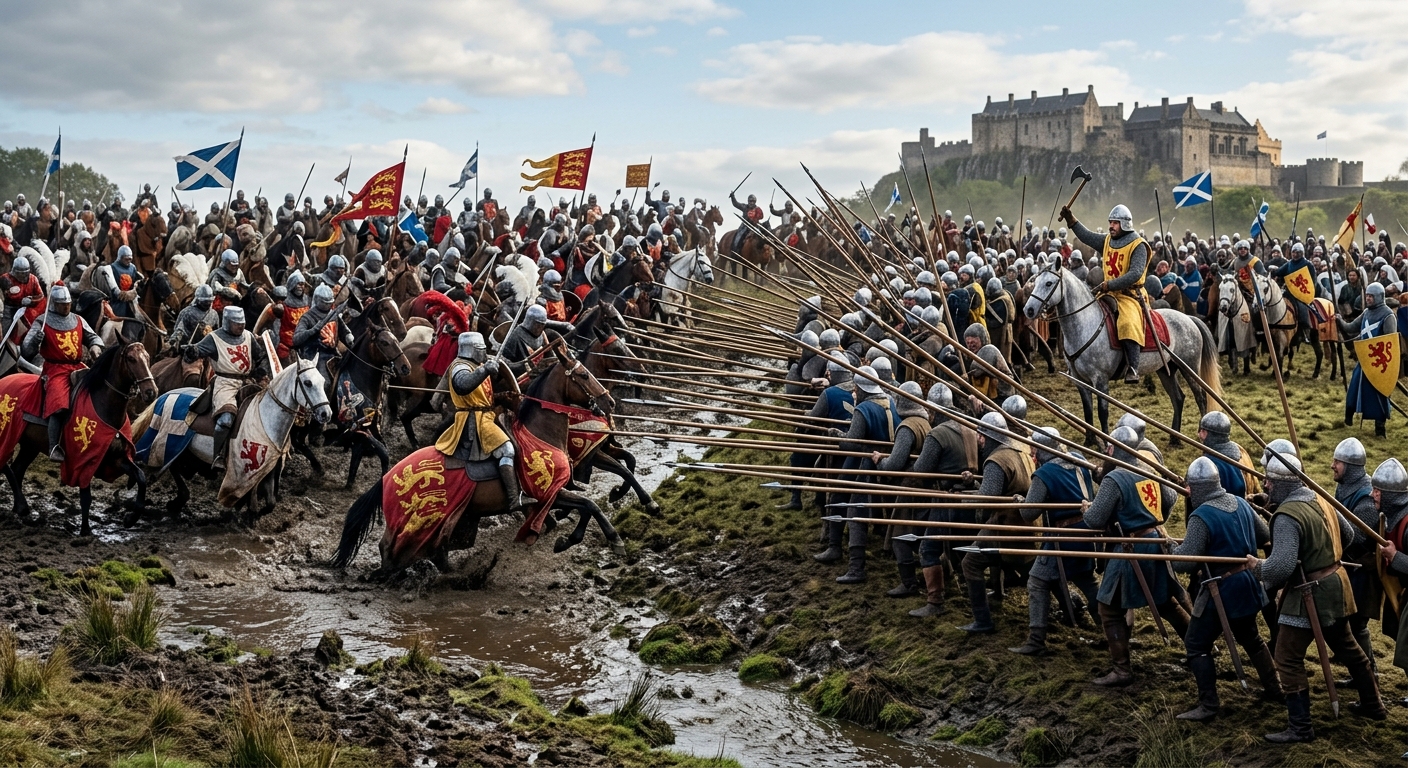
- Broadly speaking, the Middle Ages (or medieval period) spans a thousand years, from the end of the Roman Empire in AD 476 up until 1485.
- However, the focus here is on the period after the Norman Conquest.
- It was a time of almost constant war.
- The English kings fought with the Welsh, Scottish and Irish noblemen for control of their lands.
- In Wales, the English were able to establish their rule.
- In 1284 King Edward I of England introduced the Statute of Rhuddlan, which annexed Wales to the Crown of England.
- Huge castles, including Conwy and Caernarvon, were built to maintain this power.
- By the middle of the 15th century the last Welsh rebellions had been defeated.
- English laws and the English language were introduced.
- In Scotland, the English kings were less successful.
- In 1314 the Scottish, led by Robert the Bruce, defeated the English at the Battle of Bannockburn, and Scotland remained unconquered by the English.
- At the beginning of the Middle Ages, Ireland was an independent country.
- The English first went to Ireland as troops to help the Irish king and remained to build their own settlements.
- By 1200, the English ruled an area of Ireland known as the Pale, around Dublin.
- Some of the important lords in other parts of Ireland accepted the authority of the English king.
- During the Middle Ages, the English kings also fought a number of wars abroad.
- Many knights took part in the Crusades, in which European Christians fought for control of the Holy Land.
- English kings also fought a long war with France, called the Hundred Years War (even though it actually lasted 116 years).
- One of the most famous battles of the Hundred Years War was the Battle of Agincourt in 1415, where King Henry V’s vastly outnumbered English army defeated the French.
- The English left France in the 1450s.
☠️
The Black Death
- The Normans used a system of land ownership known as feudalism.
- The king gave land to his lords in return for help in war.
- Landowners had to send certain numbers of men to serve in the army.
- Some peasants had their own land but most were serfs.
- They had a small area of their lord’s land where they could grow food.
- In return, they had to work for their lord and could not move away.
- The same system developed in southern Scotland.
- In the north of Scotland and Ireland, land was owned by members of the ‘clans’ (prominent families).
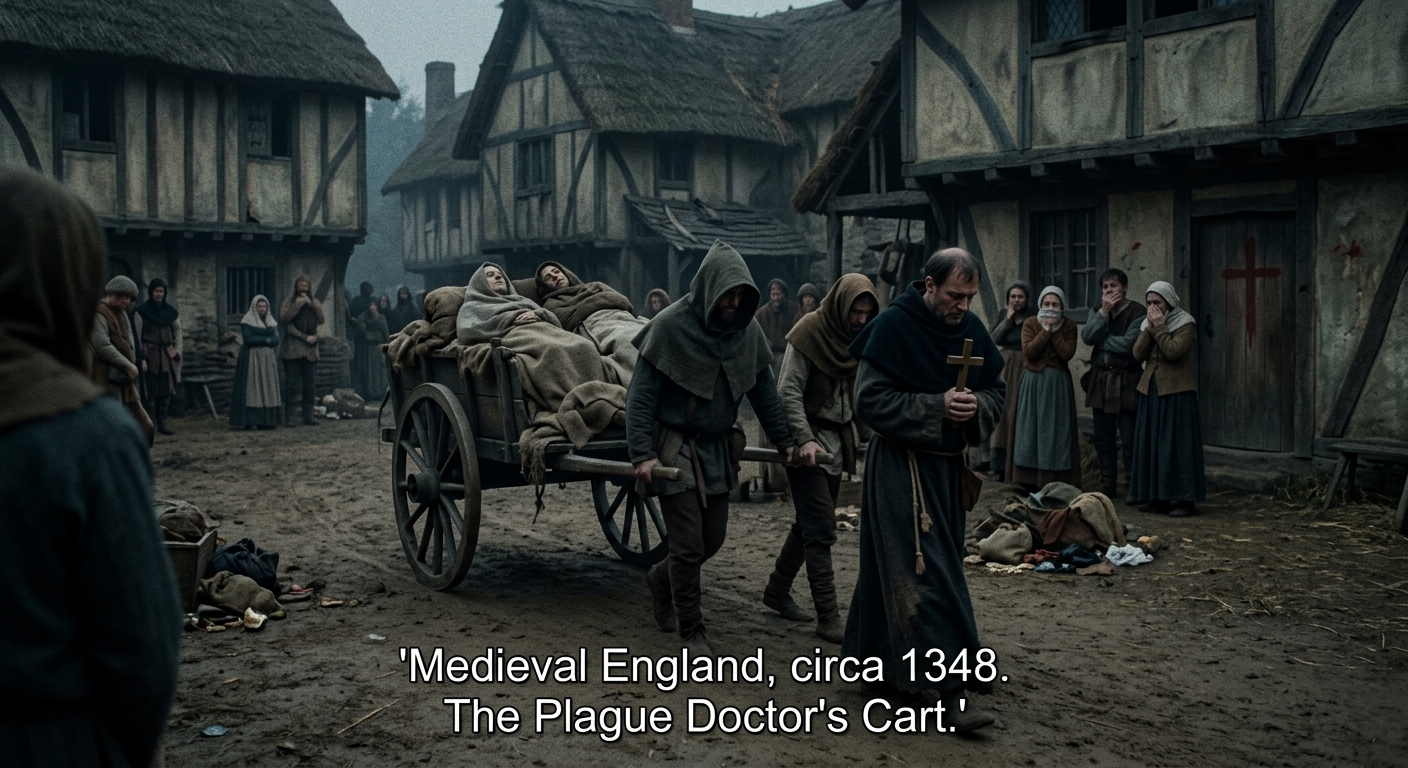
- In 1348, a disease, probably a form of plague, came to Britain.
- This was known as the Black Death.
- One third of the population of England died and a similar proportion in Scotland and Wales.
- This was one of the worst disasters ever to strike Britain.
- Following the Black Death, the smaller population meant there was less need to grow cereal crops.
- There were labour shortages and peasants began to demand higher wages.
- New social classes appeared, including owners of large areas of land (later called the gentry), and people left the countryside to live in the towns.
- In the towns, growing wealth led to the development of a strong middle class.
- In Ireland, the Black Death killed many in the Pale and, for a time, the area controlled by the English became smaller.
⚖️
Legal and political changes
- In the Middle Ages, Parliament began to develop into the institution it is today.
- Its origins can be traced to the king’s council of advisers, which included important noblemen and the leaders of the Church.
- There were few formal limits to the king’s power until 1215.
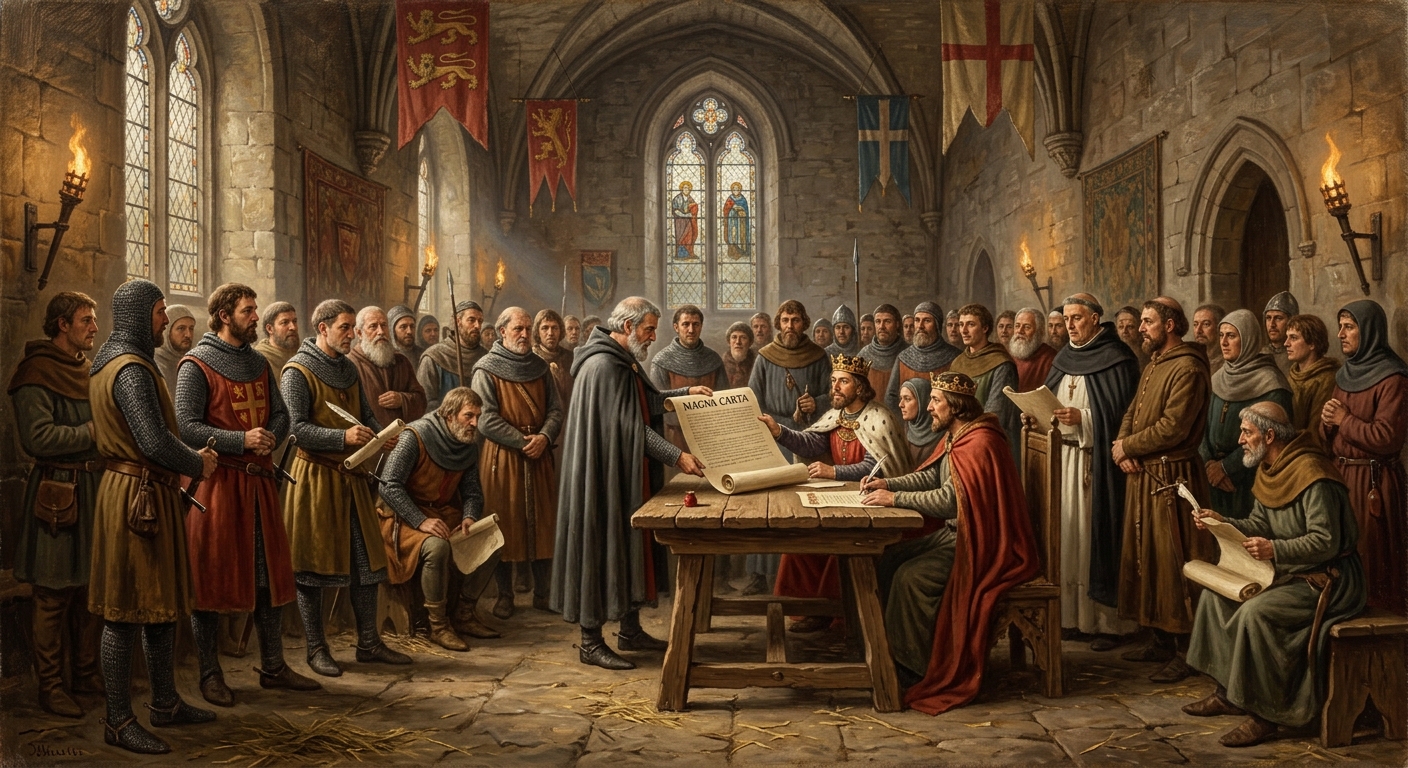
- In that year, King John was forced by his noblemen to agree to a number of demands.
- The result was a charter of rights called the Magna Carta (which means the Great Charter).
- The Magna Carta established the idea that even the king was subject to the law.
- It protected the rights of the nobility and restricted the king’s power to collect taxes or to make and change laws.
- In future, the king would need to involve his noblemen in decisions.
- In England, parliaments were called for the king to consult his nobles, particularly when the king needed to raise money.
- The numbers attending Parliament increased and two separate parts, known as Houses were established.
- This nobility, great landowners and bishops sat in the House of Lords.
- Knights, who were usually smaller landowners, and wealthy people from towns and cities were elected to sit in the House of Commons.
- Only a small part of the population was able to join in electing the members of the Commons.
- A similar Parliament developed in Scotland.
- It had three Houses, called Estates: the lords, the commons and the clergy.
- This was also a time of development in the legal system.
- The principle that judges are independent of the government began to be established.
- In England, judges developed ‘common law’ by a process of precedence (that is, following previous decisions) and tradition.
- In Scotland, the legal system developed slightly differently and laws were ‘codified’ (that is, written down).
📜
A distinct identity
- The Middle Ages saw the development of a national culture and identity.
- After the Norman Conquest, the king and his noblemen had spoken Norman French and the peasants had continued to speak Anglo-Saxon.
- Gradually these two languages combined to become one English language.
- Some words in modern English – for example, ‘park’ and ‘beauty’ – are based on Norman French words.
- Others – for example, ‘apple’, ‘cow’ and ‘summer’ – are based on Anglo-Saxon words.
- In modern English there are often two words with very similar meanings, one from French and one from Anglo-Saxon.
- ‘Demand’ (French) and ‘ask’ (Anglo-Saxon) are examples.
- By 1400, in England, official documents were being written in English, and English had become the preferred language of the royal court and Parliament.
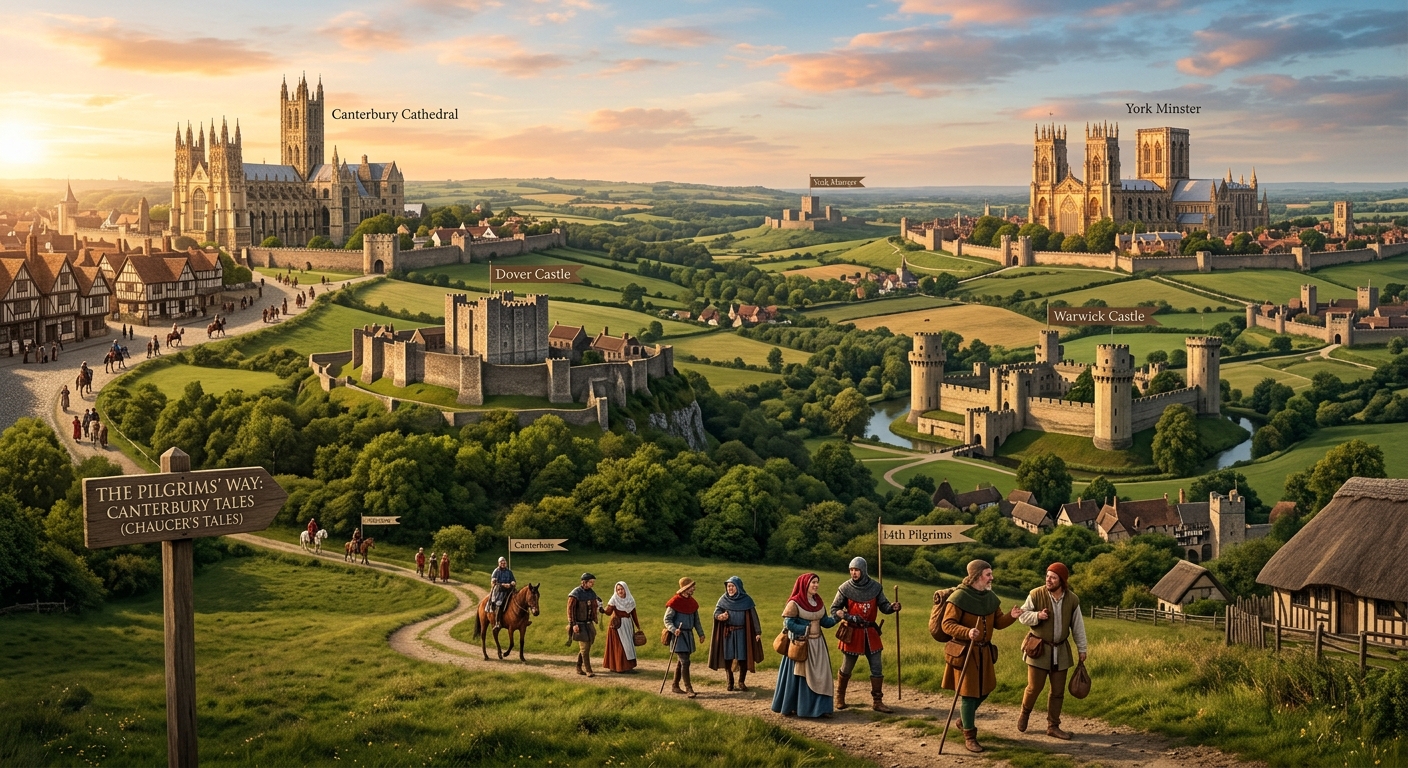
- In the years leading up to 1400, Geoffrey Chaucer wrote a series of poems in English about a group of people going to Canterbury on a pilgrimage.
- The people decided to tell each other stories on the journey, and the poems describe the travellers and some of the stories they told.
- This collection of poems is called The Canterbury Tales.
- It was one of the first books to be printed by William Caxton, the first person in England to print books using a printing press.
- Many of the stories are still popular.
- Some have been made into plays and television programmes.
- In Scotland, many people continued to speak Gaelic and the Scots language also developed.
- A number of poets began to write in the Scots language.
- One example is John Barbour, who wrote The Bruce about the Battle of Bannockburn.
- The Middle Ages also saw a change in the type of buildings in Britain.
- Castles were built in many places in Britain and Ireland, partly for defence.
- Today many are in ruins, although some, such as Windsor and Edinburgh, are still in use.
- Great cathedrals – for example, Lincoln Cathedral – were also built, and many of these are still used for worship.
- Several of the cathedrals had windows of stained glass, telling stories about the Bible and Christian saints.
- The glass in York Minster is a famous example.
- During this period, England was an important trading nation.
- English wool became a very important export.
- People came to England from abroad to trade and also to work.
- Many had special skills, such as weavers from France, engineers from Germany, glass manufacturers from Italy and canal builders from Holland.
⚔️
The Wars of the Roses
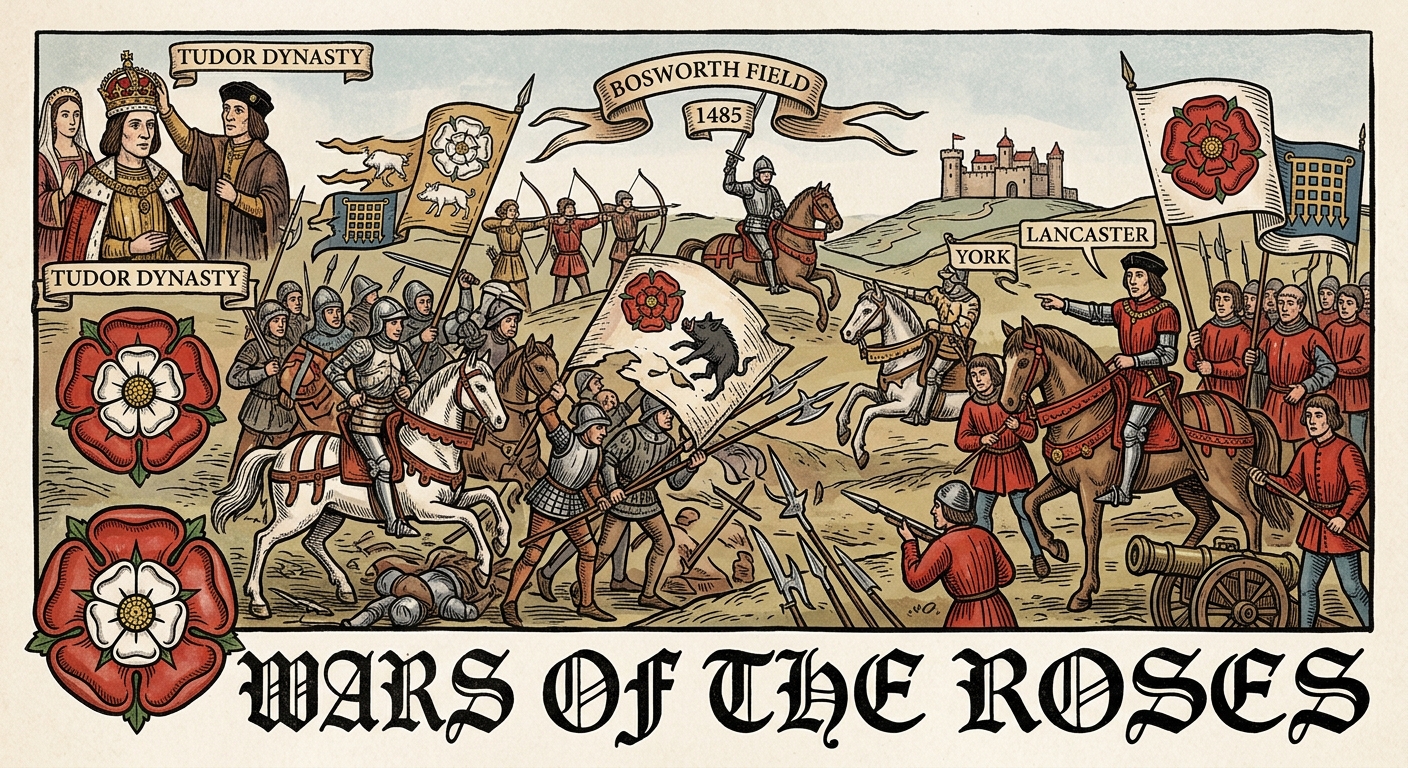
- In 1455, a civil war was begun to decide who should be king of England.
- It was fought between the supporters of two families: the House of Lancaster and the House of York.
- This war was called the Wars of the Roses, because the symbol of Lancaster was a red rose and the symbol of York was a white rose.
- The wars ended with the Battle of Bosworth Field in 1485.
- King Richard III of the House of York was killed in the battle and Henry Tudor, the leader of the House of Lancaster, became King Henry VII.
- Henry then married King Richard’s niece, Elizabeth of York, and united the two families.
- Henry was the first king of the House of Tudor.
- The symbol of the House of Tudor was a red rose with a white rose inside it as a sign that the Houses of York and Lancaster were now allies.
✅ Self-check — can you explain each of these?