⚔️
The First World War
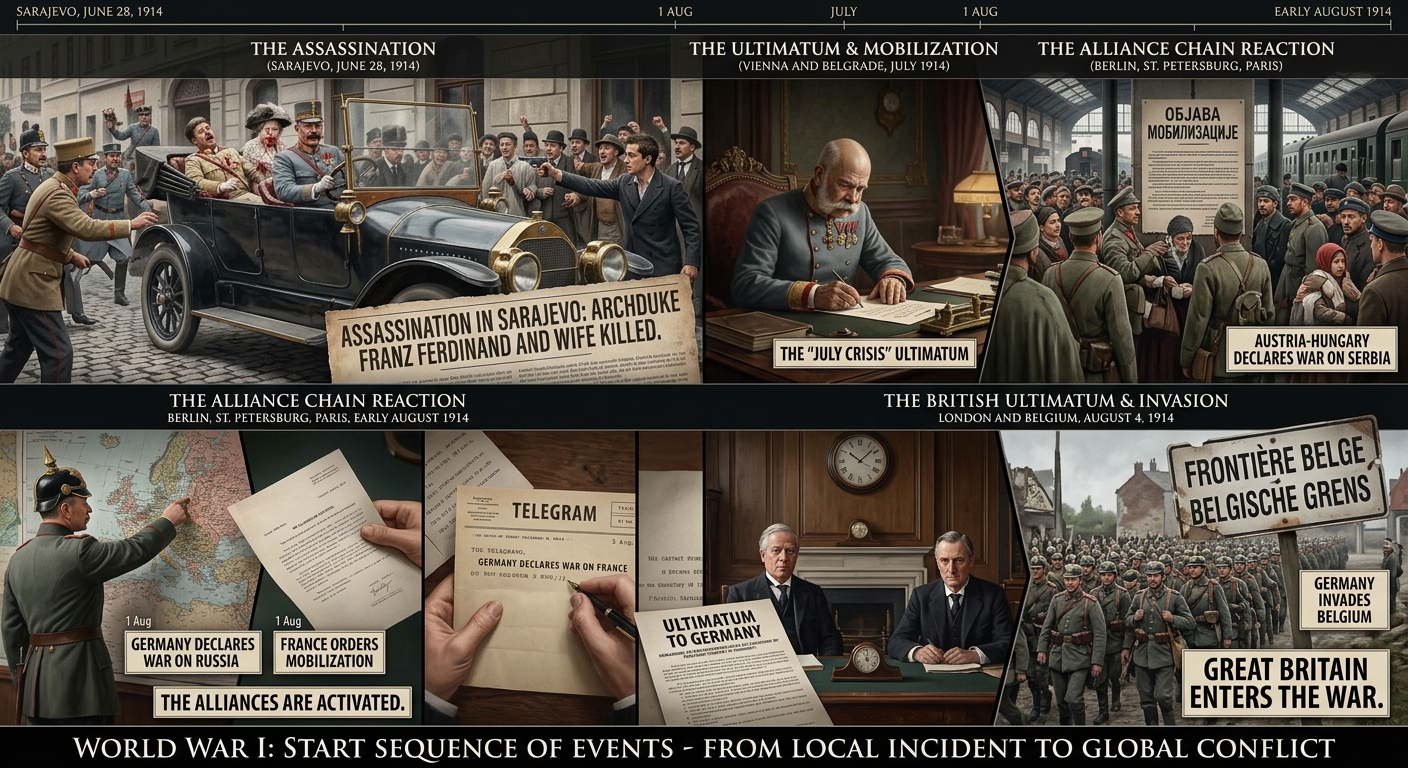
- The early 20th century was a time of optimism in Britain.
- The nation, with its expansive Empire, well-admired navy, thriving industry and strong political institutions, was what is now known as a global ‘superpower’.
- It was also a time of social progress.
- Financial help for the unemployed, old-age pensions and free school meals were just a few of the important measures introduced.
- Various laws were passed to improve safety in the workplace; town planning rules were tightened to prevent the further development of slums; and better support was given to mothers and their children after divorce or separation.
- Local government became more democratic and a salary for members of Parliament (MPs) was introduced for the first time, making it easier for more people to take part in public life.
- This era of optimism and progress was cut short when war broke out between several European nations.
- On 28 June 1914, Archduke Franz Ferdinand of Austria was assassinated.
- This set off a chain of events leading to the First World War (1914-18).
- But while the assassination provided the trigger for war, other factors – such as a growing sense of nationalism in many European states; increasing militarism; imperialism; and the division of the major European powers into two camps – all set the conditions for war.
- The conflict was centred in Europe, but it was a global war involving nations from around the world.
- Britain was part of the Allied Powers, which included (amongst others) France, Russia, Japan, Belgium, Serbia – and later, Greece, Italy, Romania and the United States.
- The whole of the British Empire was involved in the conflict – for example, more than a million Indians fought on behalf of Britain in lots of different countries, and around 40,000 were killed.
- Men from the West Indies, Africa, Australia, New Zealand and Canada also fought with the British.
- The Allies fought against the Central Powers – mainly Germany, the Austro-Hungarian Empire, the Ottoman Empire and later Bulgaria.
- Millions of people were killed or wounded, with more than 2 million British casualties.
- One battle, the British attack of the Somme in July 1916, resulted in about 60,000 British casualties on the first day alone.
- The First World War ended at 11.00 am on 11th November 1918 with victory for Britain and its allies.
🎨
The partition of Ireland
- In 1913, the British government promised ‘Home Rule’ for Ireland.
- The proposal was to have a self-governing Ireland with its own parliament but still part of the UK.
- A Home Rule Bill was introduced in Parliament.
- It was opposed by the Protestants in the north of Ireland, who threatened to resist Home Rule by force.
- The outbreak of the First World War led the British government to postpone any changes in Ireland.
- Irish Nationalists were not willing to wait and in 1916 there was an uprising (the Easter Rising) against the British in Dublin.
- The leaders of the uprising were executed under military law.
- A guerrilla war against the British army and the police in Ireland followed.
- In 1921 a peace treaty was signed and in 1922 Ireland became two countries.
- The six counties in the north which were mainly Protestant remained part of the UK under the name Northern Ireland.
- The rest of Ireland became the Irish Free State.
- It had its own government and became a republic in 1949.
- There were people in both parts of Ireland who disagree with the split between the North and the South.
- They still wanted Ireland to be one independent country.
- Years of disagreement led to a terror campaign in Northern Ireland and elsewhere.
- The conflict between those wishing for full Irish independence and those wishing to remain loyal to the British government is often referred to as ‘the Troubles’.
⚔️
The inter-war period
- In the 1920s, many people’s living conditions got better.
- There were improvements in public housing and new homes were built in many towns and cities.
- However, in 1929, the world entered the ‘Great Depression’ and some parts of the UK suffered mass unemployment.
- The effects of the depression of the 1930s were felt differently in different parts of the UK.
- The traditional heavy industries such as shipbuilding were badly affected but new industries – including the automobile and aviation industries – developed.
- As prices generally fell, those in work had more money to spend.
- Car ownership doubled from 1 million to 2 million between 1930 and 1939.
- In addition, many new houses were built.
- It was also a time of cultural blossoming, with writers such as Graham Greene and Evelyn Waugh prominent.
- The economist John Maynard Keynes published influential new theories of economics.
- The BBC started radio broadcasts in 1922 and began the world’s first regular television service in 1936.
⚔️
The Second World War
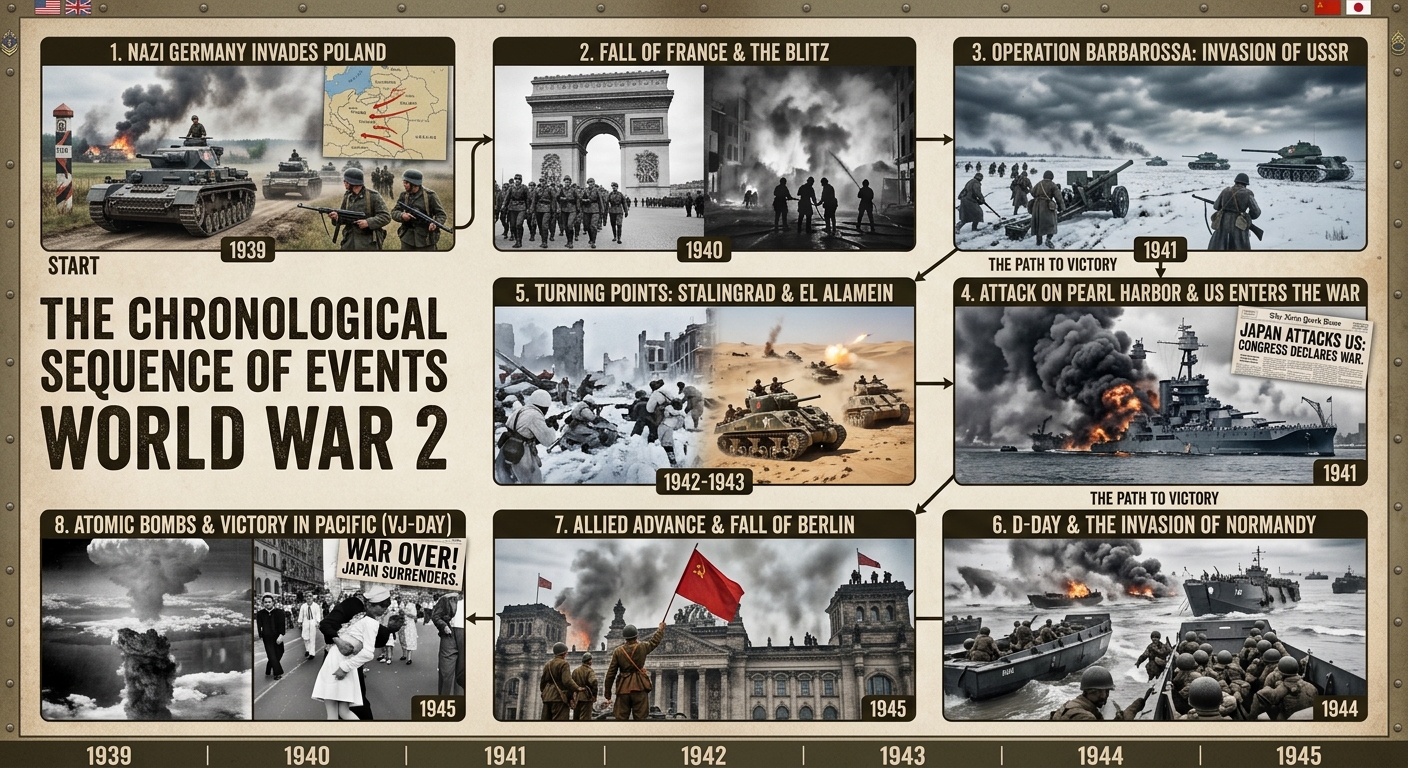
- Adolf Hitler came to power in Germany in 1933.
- He believed that the conditions imposed on Germany by the Allies after the First World War were unfair; he also wanted to conquer more land for the German people.
- He set about renegotiating treaties, building up arms, and testing Germany’s military strength in nearby countries.
- The British government tried to avoid another war.
- However, when Hitler invaded Poland in 1939, Britain and France declared war in order to stop his aggression.
- The war was initially fought between the Axis powers (fascist Germany and Italy and the Empire of Japan) and the Allies.
- The main countries on the allied side were the UK, France, Poland, Austria, New Zealand, Canada, and the Union of South Africa.
- Having occupied Austria and invaded Czechoslovakia, Hitler followed his invasion of Poland by taking control of Belgium and the Netherlands.
- Then, in 1940, German forces defeated allied troops and advanced through France.
- At this time of national crisis, Winston Churchill became Prime Minister and Britain’s war leader.
✅ Self-check — can you explain each of these?